INTERVIEW: Supergroup Close Enemies Set for Pair of New England Shows (11.07 – 11.08)
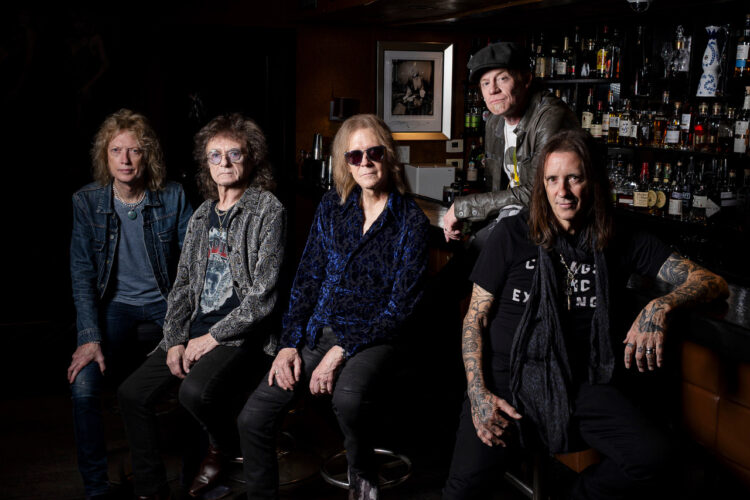
Peter Stroud is on Zoom from his basement in Atlanta, and the place looks a little stripped down. Usually there are more amps down there, he says. He’s been borrowing them for the road. That basement is where Close Enemies got built. The group consists of Aerosmith bassist Tom Hamilton, with drummer Tony Brock (The Babys, Rod Stewart), guitarists Stroud (Sheryl Crow) and Trace Foster, and singer Chasen Hampton. Lyricist Gary Stier is the sixth man on the songs. Their self-titled debut arrived in March on TLG|ROCK. I recently caught up wiht three of the band’s five members for about an hour.
Close Enemies have two upcoming New England area shows:
November 7th at Blue Ocean Music Hall in Salisbury, MA at 8 pm (TICKETS)
November 8th at Nashua Center for the Arts in Nashua, NH at 7 pm (TICKETS)
Jaffer Hasan: Where are you right now, and what’s the last thing you played together?
Peter Stroud: I’m in my basement in Atlanta. It’s a little torn apart. Usually there are more amplifiers, but I’ve been robbing them. We just played Chicago, at the Des Plaines Theatre, in a northwestern suburb.
Chasen Hampton: We did the first half of the show, and then Steven Adler did the second half. It was kind of Hall of Fame day, with Tom Hamilton and Adler rocking it out.
Stroud: You might have noticed on the album we have a sixth member, so to speak: Gary Stier. He’s an integral part of the songwriting, and he lives in the Chicago area.
Hampton: He was there too.
Jaffer Hasan: Give me the pitch. What is Close Enemies?
Chasen Hampton: That’s a tough one. We all have different definitions. They call me the kid, even though I’m an old man at this. I can’t tell you how beautiful these guys are. Their talent is obviously insane, but their hearts are incredible. Walking into this was walking into the most perfect atmosphere, guys who just want to play and have fun. No bullshit, no drama. Let’s write some good music and show these people we’re not done, we’ve got something to say. It’s literally like we’re in Peter’s basement rocking like we’re 16, waiting for our parents to come down and tell us to turn it down.
Tony Brock: Except now it’s Peter’s wife coming down to check on us.
Peter and I had been trying to do something together for a long time, ever since I moved to Atlanta. We met when I was with Rod Stewart. It was my very first show with Rod, and Peter turned up at soundcheck. Security tried to throw him out, and he looked up at me on the stage and said, “Well, he said I could stay.” I looked at him like, okay. We’ve been friends ever since.
Now we’re on equal par. There’s no arguing. We try everything anybody brings up. If it doesn’t work, we say okay. If it works, fantastic, and everybody puts in 100 percent. It’s probably one of the most experimental and wonderful bands I’ve ever been in.
Jaffer Hasan: And you, Peter?
Peter Stroud: Without sounding egotistical, I consider us new classic rock. I don’t mean our music should automatically be considered classic. It’s new music, but we all have those sensibilities. We were raised on everything people call classic rock. And the big thing missing from classic rock radio is new music.
Tony Brock is The Babys. Tom Hamilton is Aerosmith. I remember the day I first heard The Babys on the radio, “Give Me Your Love.” I heard his drums and went, whoa. I was in my van. That would’ve been ’76, something like that. Now here I am playing with some of my heroes.
We try to put out music for the reason everybody likes classic rock: they’re great songs, they’re energetic, and you can go see them live. Those songs were written with the thought of how they’d translate to an arena or a theater full of people. You can write for somebody listening in their living room, getting into it. Or you can write like Tom Petty. You could tell he was reaching out to the audience. That’s where we’re at.
“The big thing missing from classic rock radio is new music.” — Peter Stroud
Jaffer Hasan: A lot of those classic bands were built for the stage. Plenty of newer artists aren’t.
Chasen Hampton: It’s three-minute, fifteen-second songs that go by, and as soon as you catch on, it’s over. It’s almost made for the radio. Classic rock takes you on a journey. Those songs take you to all sorts of different places.
Jaffer Hasan: Tony, what do you remember from the first time you played with Tom?
Tony Brock: It sounds corny, but it was kind of instant. I love to hold down the rhythm and occasionally show off. I was lucky enough to tour with Carl Palmer, and he taught me a bunch of stuff, but I don’t want to use it. I’m all about the groove, and Tom is so melodic. He doesn’t need to hold it down. I’m holding it down, he’s playing all these beautiful melodies, and I’m accenting everything he comes up with. He feeds off me, too. Sometimes we don’t even have to look at each other. I’m just honored to be a part of it.
Jaffer Hasan: Peter, what do you hear in the rhythm section that makes it all work?
Peter Stroud: It’s huge. Sheryl came backstage after our Nashville show and said, “Man, y’all were great, but oh my god, Tony!” It’s his energy. Tony plays musically to the song. He holds the beat, but on something like “Rain,” his playing is every bit as much a part of the composition as the groove. Most drummers now throw on the click and go. His statement is musical right out of the gate.
Same with Tom. He’s known for playing parts. Trace talks about it: try playing “Toys in the Attic,” that bass part. Tom created all these incredible parts, “Sweet Emotion” and all that. Put Tony and Tom together and it doesn’t get any better.
When I’m playing rhythm, it’s all eyes on Tony. We’ve developed this sixth sense where we don’t even have to look at each other. We can feel when we’re both going somewhere.
Jaffer Hasan: Chasen, what’s it like walking into a room of players you grew up on?
Chasen Hampton: You’ll hear me say it in the show: sometimes I just have to pinch myself. I’m in the center of it all, and I feel like I’m 16, standing in the middle of them. Then I turn around and look at Tony, and it’s his drum solo and he’s still going. I’m like, I have to go drink a glass of water.
These guys are so inspiring, watching their energy, how they handle their business and the obstacles that are always there. It’s the greatest high you’ve ever felt. It kind of fell into my lap, and it was unbelievable the way it happened.
Peter Stroud: Oh man, you earned it. And our clock stopped at 16, by the way. We’re all 16.
Jaffer Hasan: Does the electronic kit feel that different from a real kit?
Tony Brock: In the ’80s, when drum machines started, everybody was poo-pooing them, and to a certain degree they were right. But I embraced it. I was one of the first Simmons endorsees, and I had a whole separate electronic kit next to me for my drum solo. I used it for percussion, orchestra hits, bass hits. So from the ’80s up to now, I’ve grown to know what I can and cannot do.
Sometimes on the electronic kit I get ghost notes really sweet. On a real drum I have to play them harder to make them come out. On “Rain,” we went to Peter Frampton’s studio to recut the drums with real drums, because we’d saved most of the stuff we did in Peter’s basement. We did it in three days. Steam in the head, but it was fun. I got maybe 70 percent of what I played on the demos. They ended up not being demos, because they kept some of the guitars.
Peter Stroud: On “More Than I Could Ever Need,” we kept his electronic drums. What you hear on the album for that song is his electronic kit.
Tony Brock: I’ve sampled my own drums, so they sound like me anyway. It’s a different kind of feel. Some samples don’t push air on the speakers. They have no attack, and I can tell the difference immediately. But on that song, it just worked. I didn’t think I could get it that delicate, so we left it alone, and it sounds great.
Jaffer Hasan: How do you build the drum part on a song like “Sound of a Train”?
Tony Brock: “Sound of a Train” is all groove. The way Peter starts it off, that whole pocket, is magic, and it’s all dynamics. Each part is a section, and I have to be very aware of how much pressure I’m putting on the kit to drive each one. By the choruses it’s wicked, with Peter and Trace doing off-shots and triplets together.
I’ve been lucky enough to produce a lot of bands, and I write a lot of songs, which has really helped my drumming. I love to use the drums as a musical instrument, even though drummers get all the jokes. We’re the guys holding it down. We’re the goalies. We’re controlling the dynamics live. If I’m not on, everybody else is off too.
Peter Stroud: Besides screwing in light bulbs, he’s a legendary drummer.
Chasen Hampton: And he doesn’t just play drums. He’s got an incredible ear, he plays keyboard, and he sings amazing. He’s a treat to have around on every level.
fer Hasan: Peter, what does your guitar do here that it doesn’t do in the Sheryl Crow set?
Peter Stroud: They’re two different avenues. Sheryl’s songwriting dictates so much sonically, and the parts are very orchestrated between three guitars. She’s on acoustic, and we have another guitarist, Audley Freed. The way they were recorded, there are a lot of capos and special tunings. I use six or eight guitars on tour with her.
With Close Enemies, it’s rock and roll. I grew up with one guitar and one amp, and before there were pedals, one cable. When we started writing, I made that my restriction: my Marshall, an SG, and a cable, and that’s it. Now I’ve got some pedals, but it’s still all about the song and the tone, and working organically.
Tony Brock: That’s why I’ve got 20 Marshall cabinets around me.
Jaffer Hasan: Chasen, what’s the hardest song to sing?
Chasen Hampton: A lot of times the slower songs are harder, because you’re more naked. There are a lot of sustained notes. I came from a pop band, with tracks and the whole bit. We pride ourselves on none of that here: no click tracks, no backing tracks, no auto-tune. I was in a group of five singers, so I shared the lead. Now I’m the one voice out front for an hour and a half, and I can’t get so hyped up that I blow my voice out. These guys back me up with the harmonies, and I’ve loved the challenge.
Sometimes the hardest songs are the most fun. “Sound of a Train” is one of the most fun songs to sing. And your voice is different every day you wake up, so on any given night the answer could change.
Jaffer Hasan: Which song changed the most from demo to final?
Chasen Hampton: That’s hard to answer, because when we went back to record these songs, trying to recreate the demo would have been a travesty. “Sound of a Train” was the first song I auditioned into the band with. My dad was on his deathbed, and he passed away during that time. I had all sorts of emotion going, and I wanted these guys to really hear what I had. Recreating that would have been impossible.
Peter Stroud: Chasen’s vocal on “Sound of a Train” was his audition, so to speak, and it was so good it’s the final take. There’s no redoing that. Same with his backing vocals. That tells you what you need to know about Chasen.
Jaffer Hasan: If someone has to hear three songs first, what are they?
Tony Brock: “Rain” would definitely be one.
Peter Stroud: That’s our calling card. It pretty much encompasses what we’re about.
Tony Brock: It was one of the first songs we all collaborated on and bounced off each other. That’s when we found out this is for real, for me anyway. I felt free in the arrangement. I could go crazy, then pull it back, and it came out wonderful. I also think “More Than I Could Ever Need” is a great song. It’s one of our lesser known, but even Sheryl loved that one, right, Peter?
Peter Stroud: Yep.
Jaffer Hasan: Peter, you once played two sets on the same festival day, with two different bands. Walk me through it.
Peter Stroud: I’d been with Sheryl for ten or eleven years at that point. She’d just made a record with Doyle Bramhall Jr. and the guys on that album, and she decided to take that group out on the road. I happened to be in touch with Sarah McLachlan around then, and she was cranking up a tour, the Lilith Fair tour. When Sheryl let us know, I emailed Sarah and said, “Hey, do you need a guitarist?” It came together within an hour.
Sheryl’s first dates overlapped with the start of Sarah’s for a five-show crossover, so I had to play both. Sheryl’s set was an hour, then a quick half-hour break, and then I’d get ready to play with Sarah. It was pretty wild. And I caught a lot of grief from Sheryl’s band the whole time. They were trying to beat me up, and I was like, hey, I’m the one doing double duty here, not you.
But Sheryl’s such a sweetheart. The fact I’ve been with her going on 28 years speaks for her as a person. She was very cool about it, and so was Sarah. They’re all friends. It was kumbaya.
Tony Brock: She put up with you for 28 years. Wow.
Jaffer Hasan: Tony, what’s the biggest lesson from The Babys and Rod Stewart that you use now? How has your drumming changed?
Tony Brock: The Babys were a band similar to this one. We all had a goal for what our music was going to be, how we’d do it, our influences. The four of us had that same magic Close Enemies has, although that went out the window once a few members got on their high horse.
I grew up on John Bonham and everybody. I was lucky enough to be in a band called Spontaneous Combustion, which Greg Lake produced. It was one of his first productions. Greg took me into the King Crimson sessions, and I got to watch Court of the Crimson King get recorded while Eddie Offord kicked the board to make explosions. That was my first introduction to where I was going. If you’re going to end up being someone, you take what you like from everybody and still make it your own. When Peter plays and I hear him on the radio, I know it’s Peter. Hopefully people hear that in me, too.
Peter does most of the mixing, and he gets that I need to keep my sound. I’ve managed to keep it since The Babys. Ron Nevison produced us, and he’d recorded everybody from Bad Company to Zeppelin, so I learned all his tricks for recording drums. I carried that sound through six months with Eddie Money, and then to Rod Stewart. Rod was harder, because it wasn’t a one-way avenue. One minute you’re doing a drum-machine thing like “Da Ya Think I’m Sexy,” the next it’s “Hot Legs,” which is where I come in. But it was still enjoyable. We were the Rod Stewart group. We wouldn’t let him have his own dressing room. We were monsters. Some of the stories I could tell you.
Then I went to Jimmy Barnes, Australia’s number one male singer. I played with him for seven years and we had seven number ones. I co-produced a lot of it and kept my sound there too. It’s like Peter’s guitar. Give it to someone else with the same settings and it won’t sound like Peter. It’s all in the fingers. Same with drums. John Bonham would sound like John Bonham on my kit.
Chasen Hampton: It’s fun to see drummers show up, grown men falling out seeing Tony Brock, because they know that sound. Guitar players are looking at Peter going, what pedals does he have? How do you do that? Same with Tom. It’s fun just watching their reactions.
“It’s all in the fingers. Same with drums. John Bonham would sound like John Bonham on my kit.” — Tony Brock
Jaffer Hasan: I watched last year’s Black Sabbath farewell, and what stuck with me was seeing musicians from every corner of rock in one place. We don’t really have that anymore.
Peter Stroud: You’re so correct. Back in the ’70s, in Tony’s big stage days, you’d see tons of other bands and hangers-on side stage. It was a party, a musical party for everybody, not just the audience but everybody who happened to be there and was lucky enough to be backstage.
Jaffer Hasan: Last one, for all of you: who shaped how you play or sing?
Chasen Hampton: My dad, and his work ethic. I’m from Oklahoma, so it wasn’t big time, but he was a state champion in tennis and a basketball coach. When I was born, he really wanted me to be a competitive athlete. I got into competing and singing, and he took that same approach with me: a hand on the back, how to get over obstacles, how to keep going in the face of defeat, how to turn no’s into gasoline. More than singing alone, my dad’s work ethic got me there.
I have a list of favorite singers that goes on and on, from Bob Marley to Chris Cornell, but it always falls back to my dad. I know he’s watching and proud, and I wouldn’t be doing this without him.
Tony Brock: That’s probably why I play the way I do. I was lucky enough to be John Bonham’s buddy, and I still wouldn’t dream of doing some of what he came up with. People to this day can’t play some of his grooves the way he played them. But I also studied Buddy Rich. I didn’t have blinders on. I wanted to learn every aspect of drumming. Keith Moon, too. A lot of it comes down to the bands you love, their music and their professionalism.
The first rock show I ever saw was the Isle of Wight Festival. I was in two feet of mud in the audience watching Jimi Hendrix, The Who, Free, you name it. That’s when I knew that’s what I wanted to do.
Peter Stroud: I grew up in a town that didn’t get good shows, and I was too young to go anyway, so for me it was the big movies: Monterey Pop, Woodstock, Concert for Bangladesh. All three made me want to play music, and Jimi Hendrix made me want to play guitar. As I got older I’d go to the late-night Saturday screening, and I must have watched each one close to ten times. In Woodstock it was always The Who, Hendrix, Alvin Lee and Ten Years After.
The first time I heard Jimi in Monterey Pop, I was seven years old. It stunned me. That’s when I said, that’s what I want to do.
Jaffer Hasan: Gentlemen, thank you so much for your time.
Tony Brock: Yeah, thank you, buddy.
Chasen Hampton: Amen. Thank you, brother. Looking forward to seeing you rocking with us.
Peter Stroud: Great questions.
Featured image by: Ross Halfin
