INTERVIEW: Moon Base One co-founder Ali Lipman discusses the past, present, and future of Salem venue
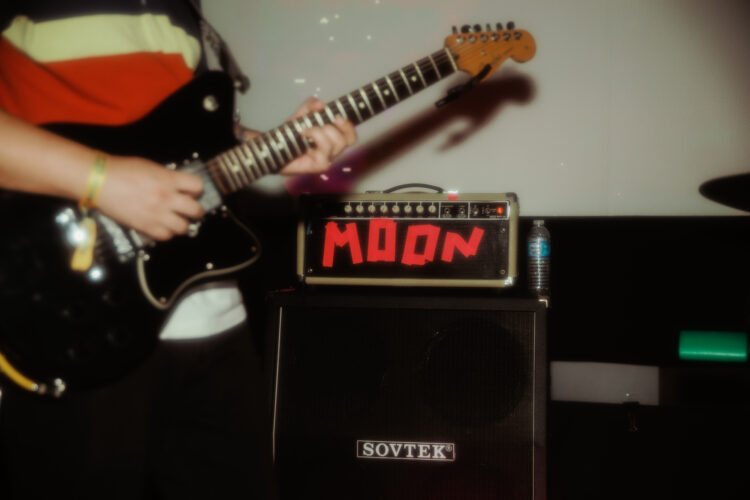
We hear it all the time- at shows, online, musicians in the press. “Support your local scene.” What does that really look like? For many people, it’s heading out to a show. Buying a t-shirt or a vinyl. Some play in bands, or maybe take photos or video, or make flyers or art for merch. It’s an ecosystem, one that we participate in because it gives us a sense of belonging. In this day and era of AI music, graphics, and video, it can often feel like the scene is gasping for air. It seems like local music is being gatekept from people under 21, and with fewer and fewer places to host all-ages events, fewer people are entering the community that needs them to thrive.
When Moon Base One opened their doors in Salem, MA, in 2025- a sober, all-ages community venue for live music and other events- it was a major beacon of hope. Run by MOON (Music Organizers of the North Shore), a non-profit whose mission is to increase access to local music across the North Shore, Moon Base One became a hub for the music community in Salem. But then, all too soon, the occupancy certificate became questioned- and things seemed grim. They were able to revive the venue for one last handful of shows, the final one being November 21, 2026. I got the opportunity to discuss with Ali Lipman, a founder and board member of MOON, about the past, present, and future of the organization, all-ages venues, how you can support MOON in the future, and some of the obstacles they’ve faced.
–
Tell me a little bit about how MOON got started! When the idea was first formed, who was there, and how did it come together to become a non-profit with a venue, annual fest, and scholarship?
Tyler and I met during the pandemic playing the Gulu Gulu open mic. We became fast friends and connected over a love of live music and a vision for how we could bring more of it to the greater Salem area. We began booking local shows as Oh, Nice Booking Collective and joined forces with Cheep Beer Booking, a group with similar philosophies in organizing our first benefit festival (at the time called Hope Fest). That was back in 2022. It was such a success that we decided to incorporate as a 501 (c) (3) called MOON (Music Organizers of the Northshore) and launch our Rising Artist Scholarship fund, which would be fed by our annual festival, renamed MOON over Salem. When we weren’t working on the festival, we partnered with local businesses like Koto, BitBar, and ChagallPAC to host local live music. When the City of Salem released its RFP for Artists’ Row in 2024, we decided to apply to create a physical community arts space in downtown Salem. We were accepted into that program and opened our doors in early 2025. Between 2025 and early 2026, we held over 100 shows and brought thousands of music lovers to downtown Salem.
Tell me about the troubles you’ve faced in the last 8 months with the city and keeping the venue open, and why you’ve all fought so hard to try to make it work?
We had a neighbor who had escalating noise complaints during our shows. We had two visits from the Salem Police Department, but we were never found in violation of the noise ordinance. Still, the city licensing committee asked us to apply for a special permit that would grant us permission to make noise during designated hours. We were granted that permit, contingent upon review of our certificate of occupancy. The newly appointed city building inspector did not approve the certificate of occupancy that their architect had recommended. She immediately reduced our occupancy subject to a set of inspections and building repairs that took almost 9 months to complete. Some repairs were common sense, but the closure represented a massive interruption to business. We were forced to rehome over 60 shows. Businesses in both Beverly and Salem like Felt Fanatic, Bit Bar, and The Bower stepped up to save our events.
It’s important to understand that the Artists’ Row program is an incubator for creative businesses. The buildings lack running water, bathrooms, or even flooring. The tenants go through an onboarding process that teaches us how to launch a business in Salem. We submit floor plans, but the city is ultimately responsible for inspecting and maintaining the buildings. MOON and the City Arts & Culture Department that administers Artists’ Row believed we had taken all required steps for operating legally and safely. The new building inspector simply held a different interpretation than the previous inspector and the city’s contracted architect.
Because building code is so interpretable, it’s important to have a building inspector who is sympathetic to music as a form of performing arts. The law, as written, couples amplified music with entertainment. Meaning that the ability to host live music is often tied to an alcohol license. We had to justify our participation in the Artists’ Row program extensively to restore our operations.
Honestly, I wish I could go back in time and fight even harder, but the entire process was a huge learning experience regarding what local business owners and small-room performance venues face, and why all-ages music has virtually disappeared from New England. We began MOON with the mission to increase access to underground music in the greater Salem area. Even though I believe that mission is important with all my heart, I couldn’t comprehend the gravity of what access actually costs in the current environment. The goal of Moon is to increase access to underground music in the greater Salem area.
What are some of the biggest obstacles that people face in accessing local music? Similarly, what are some of the obstacles that face the venues and bands in hosting accessible shows?
There are several issues at play in access to underground music. Economics play a big role in this, and we have behemoths like Live Nation and Ticketmaster to thank for driving up the costs of seeing live music performed, and killing off the small-capacity room where you would be more
likely to see local and up-and-coming artists perform. There are also rising costs and rising liability from a business-owner standpoint, which is why we’ve seen age minimums crawl up to 21+ for shows. Gone are the days when you could attend a show in a small-capacity room with X’s on your hands. Most businesses aren’t able to stomach the costs and the risks associated with these types of events. Typically, the event itself doesn’t drive revenue; alcohol sales do. So, it makes sense that the trade-offs might not feel worth it to a small business owner.
The non-profit space is no better. Funding is limited, often short-term, and difficult to get. Economic swings make regular gifts, memberships, and sponsorships difficult to forecast, and scaling an organization without reliable revenue is nearly impossible. This forces local music underground. Sometimes literally into basements, warehouses, and other venues that are not up to code and present actual life safety risks. In these cases, someone’s ability to access the music depends on personal connections, which is its own barrier. I think what’s important to note is that the human drive to make and connect with music doesn’t change because federal and local policy discourages it. It only makes it less safe to access.
Do you remember any all-ages spaces in particular in your youth that you returned to over and over again? Why are these spaces so important?
The Fishtown Artspace in Gloucester, MA was the all-ages music space of my youth where I caught this bug. It rewired my brain. I knew I loved music. I was in chorus, played piano, and was in the musicals. I fell asleep listening to WFNX every night on my alarm clock radio. I had a stack of punk and metal CDs that I rotated in my CD player for the bus rides to and from school every day. Even so, I credit walking into the Artspace at 14 or 15 as my first experience with belonging.
These types of spaces cultivate different things for different people, but what I hear a lot from young people who come to MOON is that they have nowhere else they’re allowed to be. Being young is criminalized. If you’re outside and not buying something, you’re often treated as trespassing. If you’re making art in public, you’re often treated like a vandal. If you’re working on your car in your parents’ garage, it’s noise complaints.
An all-ages venue gives young people the opportunity to interact across generational lines, and it’s often the first place they get to make music outside of school. That can’t be understated. It’s a pipeline for creativity, a safe place to explore identity and belonging, and a place to hang out when the rest of the world doesn’t want to see you.
Don’t get me wrong, it’s important to us oldheads too. We have hosted an organization that helps recently sober young adults find non-substance-centric activities in the community. We have hosted families, first shows, touring bands from all over the world, high school bands, old band reunions, open-mics, acoustic showcases, and more. It’s a cultural exchange, and a magic that can really only happen when a community has a space that allows it to bloom.
I’d love to hear about the Rising Artist Scholarship MOON provides- who does that go to and what is it for? If you had been a recipient, what would you have used it for?
The Rising Artist Scholarship is a fund we began for college-bound prospective music and arts students, and we raise money for it each year through our Moon Over Salem city-wide festival. We have given $10k in scholarships over the past 3 years to students in the community, usually in amounts from $1k-2k. Every spring we work with area high schools to identify candidates for the award and attend scholarship award nights. It’s one of the programs at MOON I am most proud of.
I was very lucky at Ipswich High School to receive similar scholarships towards my music business degree! I definitely used them to help pay for my freshman year of college and reduce my overall debt, which future-me thanked me for, but we don’t restrict our funds. We would also
be very happy if recipients use the scholarship money to help pay for books and supplies.
What does the next couple of months look like for the organization?
We are now into our final month of programming on Artists’ Row, and we have the very unfun job of returning our stall to its natural state in December. That means painting the walls, removing the stage, cleaning, and lots and lots of sweeping. After we’re done licking our wounds, we’ll discuss what comes next for MOON. We plan to hold Moon Over Salem in 2027, as well as some pop-up events around Salem. We won’t be able to hold as many shows as we did in 2025 and 2026, but we’ll be looking for ways to work with the city and local businesses to continue to increase access to underground music.
Where do you see MOON in a year from now? Five years from now?
I would like to develop a political platform to help change policies impacting access to underground music. I think there are a lot of city officials, elected officials, and business owners in Salem and surrounding communities that want to see these types of changes occur.
How can your community support you right now, and in the future?
We are always accepting donations, but the best way to support us right now is to reach out to your city councilors and state representatives and tell them you want all-ages music in your city.
We hope to see many familiar faces at our last events at Moon Base One!
Moon Base One:
Featured image by: Cat Meade
